Filter by type:
Filter by tags:

deepseek-v4-flash-spark-exl3-vllm-cpp
DeepSeek V4 Flash's Spark and GB10-oriented REAP-K216 EXL3 checkpoint,
served by vllm.cpp. It needs CUDA and roughly 100 GiB for its large
rank-sliced checkpoint.
The repository is pinned to its latest recorded revision. vllm.cpp's
existing runtime evidence measured the older 22f28d32b9b29b4352eaa380ff8c2c170b2847ab
revision; this entry does not claim that the newer revision has passed the
same end-to-end gate.
Repository: localai

allenai_olmo-3.1-32b-think
The **Olmo-3.1-32B-Think** model is a large language model (LLM) optimized for efficient inference using quantized versions. It is a quantized version of the original **allenai/Olmo-3.1-32B-Think** model, developed by **bartowski** using the **imatrix** quantization method.
### Key Features:
- **Base Model**: `allenai/Olmo-3.1-32B-Think` (unquantized version).
- **Quantized Versions**: Available in multiple formats (e.g., `Q6_K_L`, `Q4_1`, `bf16`) with varying precision (e.g., Q8_0, Q6_K_L, Q5_K_M). These are derived from the original model using the **imatrix calibration dataset**.
- **Performance**: Optimized for low-memory usage and efficient inference on GPUs/CPUs. Recommended quantization types include `Q6_K_L` (near-perfect quality) or `Q4_K_M` (default, balanced performance).
- **Downloads**: Available via Hugging Face CLI. Split into multiple files if needed for large models.
- **License**: Apache-2.0.
### Recommended Quantization:
- Use `Q6_K_L` for highest quality (near-perfect performance).
- Use `Q4_K_M` for balanced performance and size.
- Avoid lower-quality options (e.g., `Q3_K_S`) unless specific hardware constraints apply.
This model is ideal for deploying on GPUs/CPUs with limited memory, leveraging efficient quantization for practical use cases.
Repository: localaiLicense: apache-2.0

qwen3-vl-32b-instruct
Qwen3-VL-32B-Instruct is the 32B parameter model of the Qwen3-VL series.
Repository: localaiLicense: apache-2.0

ibm-granite_granite-4.0-h-small
Granite-4.0-H-Small is a 32B parameter long-context instruct model finetuned from Granite-4.0-H-Small-Base using a combination of open source instruction datasets with permissive license and internally collected synthetic datasets. This model is developed using a diverse set of techniques with a structured chat format, including supervised finetuning, model alignment using reinforcement learning, and model merging. Granite 4.0 instruct models feature improved instruction following (IF) and tool-calling capabilities, making them more effective in enterprise applications.
Repository: localaiLicense: apache-2.0
qwen3-32b
Qwen3 is the latest generation of large language models in Qwen series, offering a comprehensive suite of dense and mixture-of-experts (MoE) models. Built upon extensive training, Qwen3 delivers groundbreaking advancements in reasoning, instruction-following, agent capabilities, and multilingual support, with the following key features:
Uniquely support of seamless switching between thinking mode (for complex logical reasoning, math, and coding) and non-thinking mode (for efficient, general-purpose dialogue) within single model, ensuring optimal performance across various scenarios.
Significantly enhancement in its reasoning capabilities, surpassing previous QwQ (in thinking mode) and Qwen2.5 instruct models (in non-thinking mode) on mathematics, code generation, and commonsense logical reasoning.
Superior human preference alignment, excelling in creative writing, role-playing, multi-turn dialogues, and instruction following, to deliver a more natural, engaging, and immersive conversational experience.
Expertise in agent capabilities, enabling precise integration with external tools in both thinking and unthinking modes and achieving leading performance among open-source models in complex agent-based tasks.
Support of 100+ languages and dialects with strong capabilities for multilingual instruction following and translation.
Qwen3-32B has the following features:
Type: Causal Language Models
Training Stage: Pretraining & Post-training
Number of Parameters: 32.8B
Number of Paramaters (Non-Embedding): 31.2B
Number of Layers: 64
Number of Attention Heads (GQA): 64 for Q and 8 for KV
Context Length: 32,768 natively and 131,072 tokens with YaRN.
For more details, including benchmark evaluation, hardware requirements, and inference performance, please refer to our blog, GitHub, and Documentation.
Repository: localaiLicense: apache-2.0

shuttleai_shuttle-3.5
A fine-tuned version of Qwen3 32b, emulating the writing style of Claude 3 models and thoroughly trained on role-playing data.
Uniquely support of seamless switching between thinking mode (for complex logical reasoning, math, and coding) and non-thinking mode (for efficient, general-purpose dialogue) within single model, ensuring optimal performance across various scenarios.
Significantly enhancement in its reasoning capabilities, surpassing previous QwQ (in thinking mode) and Qwen2.5 instruct models (in non-thinking mode) on mathematics, code generation, and commonsense logical reasoning.
Superior human preference alignment, excelling in creative writing, role-playing, multi-turn dialogues, and instruction following, to deliver a more natural, engaging, and immersive conversational experience.
Expertise in agent capabilities, enabling precise integration with external tools in both thinking and unthinking modes and achieving leading performance among open-source models in complex agent-based tasks.
Support of 100+ languages and dialects with strong capabilities for multilingual instruction following and translation.
Shuttle 3.5 has the following features:
Type: Causal Language Models
Training Stage: Pretraining & Post-training
Number of Parameters: 32.8B
Number of Paramaters (Non-Embedding): 31.2B
Number of Layers: 64
Number of Attention Heads (GQA): 64 for Q and 8 for KV
Context Length: 32,768 natively and 131,072 tokens with YaRN.
Repository: localaiLicense: apache-2.0
qwen-3-32b-medical-reasoning-i1
This is https://huggingface.co/kingabzpro/Qwen-3-32B-Medical-Reasoning applied to https://huggingface.co/Qwen/Qwen3-32B Original model card created by @kingabzpro
Original model card from @kingabzpro
Fine-tuning Qwen3-32B in 4-bit Quantization for Medical Reasoning
This project fine-tunes the Qwen/Qwen3-32B model using a medical reasoning dataset (FreedomIntelligence/medical-o1-reasoning-SFT) with 4-bit quantization for memory-efficient training.
Repository: localaiLicense: apache-2.0
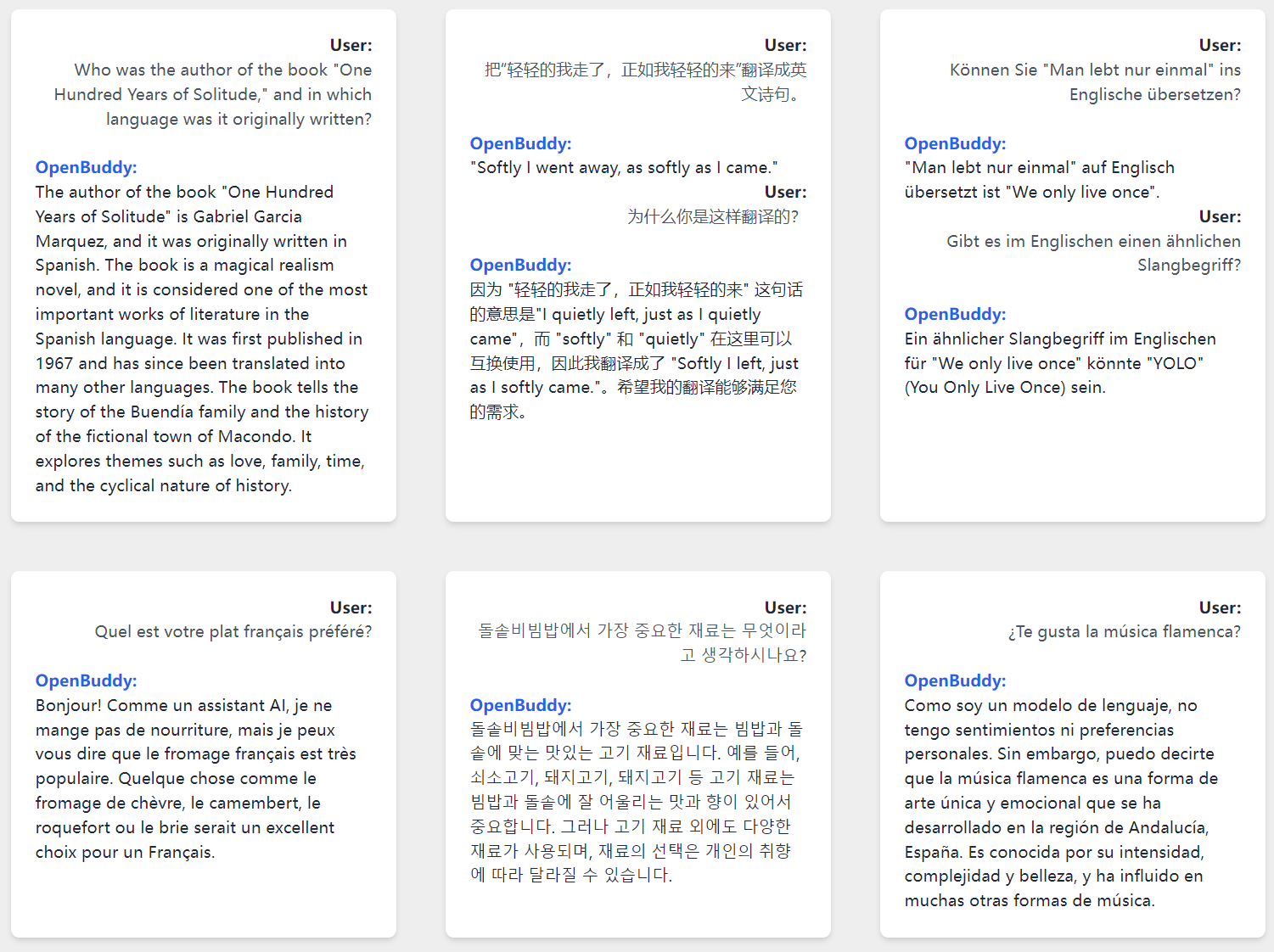
openbuddy_openbuddy-r1-0528-distill-qwen3-32b-preview0-qat
OpenBuddy distillation of Qwen3-32B from DeepSeek-R1, featuring 40K context window and multilingual support (zh, en, fr, de, ja, ko, it, fi). GGUF quantized version optimized for local inference with llama.cpp.
Repository: localaiLicense: apache-2.0

yanfei-v2-qwen3-32b
A repair of Yanfei-Qwen-32B by TIES merging huihui-ai/Qwen3-32B-abliterated, Zhiming-Qwen3-32B, and Menghua-Qwen3-32B using mergekit.
Repository: localaiLicense: apache-2.0

agentica-org_deepswe-preview
DeepSWE-Preview is a fully open-sourced, state-of-the-art coding agent trained with only reinforcement learning (RL) to excel at software engineering (SWE) tasks. DeepSWE-Preview demonstrates strong reasoning capabilities in navigating complex codebases and viewing/editing multiple files, and it serves as a foundational model for future coding agents. The model achieves an impressive 59.0% on SWE-Bench-Verified, which is currently #1 in the open-weights category.
DeepSWE-Preview is trained on top of Qwen3-32B with thinking mode enabled. With just 200 steps of RL training, SWE-Bench-Verified score increases by ~20%.
Repository: localaiLicense: mit

compumacy-experimental-32b
A Specialized Language Model for Clinical Psychology & Psychiatry
Compumacy-Experimental_MF is an advanced, experimental large language model fine-tuned to assist mental health professionals in clinical assessment and treatment planning. By leveraging the powerful unsloth/Qwen3-32B as its base, this model is designed to process complex clinical vignettes and generate structured, evidence-based responses that align with established diagnostic manuals and practice guidelines.
This model is a research-focused tool intended to augment, not replace, the expertise of a licensed clinician. It systematically applies diagnostic criteria from the DSM-5-TR, references ICD-11 classifications, and cites peer-reviewed literature to support its recommendations.
Repository: localaiLicense: apache-2.0
zhi-create-qwen3-32b-i1
Zhi-Create-Qwen3-32B is a fine-tuned model derived from Qwen/Qwen3-32B, with a focus on enhancing creative writing capabilities. Through careful optimization, the model shows promising improvements in creative writing performance, as evaluated using the WritingBench. In our evaluation, the model attains a score of 82.08 on WritingBench, which represents a significant improvement over the base Qwen3-32B model's score of 78.97.
Additionally, to maintain the model's general capabilities such as knowledge and reasoning, we performed fine-grained data mixture experiments by combining general knowledge, mathematics, code, and other data types. The final evaluation results show that general capabilities remain stable with no significant decline compared to the base model.
Repository: localaiLicense: apache-2.0

planetoid_27b_v.2
This is a merge of pre-trained gemma3 language models
Goal of this merge was to create good uncensored gemma 3 model good for assistant and roleplay, with uncensored vision.
First, vision: i dont know is it normal, but it slightly hallucinate (maybe q3 is too low?), but lack any refusals and otherwise work fine. I used default gemma 3 27b mmproj.
Second, text: it is slow on my hardware, slower than 24b mistral, speed close to 32b QWQ. Model is smart even on q3, responses are adequate in length and are interesting to read. Model is quite attentive to context, tested up to 8k - no problems or degradation spotted. (beware of your typos, it will copy yours mistakes) Creative capabilities are good too, model will create good plot for you, if you let it. Model follows instructions fine, it is really good in "adventure" type of cards. Russian is supported, is not too great, maybe on higher quants is better. Refusals was not encountered.
However, i find this model not unbiased enough. It is close to neutrality, but i want it more "dark". Positivity highly depends on prompts. With good enough cards model can do wonders.
Tested on Q3_K_L, t 1.04.
Repository: localaiLicense: gemma

primeintellect_intellect-2
INTELLECT-2 is a 32 billion parameter language model trained through a reinforcement learning run leveraging globally distributed, permissionless GPU resources contributed by the community.
The model was trained using prime-rl, a framework designed for distributed asynchronous RL, using GRPO over verifiable rewards along with modifications for improved training stability. For detailed information on our infrastructure and training recipe, see our technical report.
Repository: localaiLicense: apache-2.0

thedrummer_valkyrie-49b-v1
it swears unprompted 10/10 model
... characters work well, groups work well, scenarios also work really well so great model overall
This is pretty exciting though. GLM-4 already had me on the verge of deleting all of my other 32b and lower models. I got to test this more but I think this model at Q3m is the death blow lol
Smart Nemotron 49b learned how to roleplay
Even without thinking it rock solid at 4qm.
Without thinking is like 40-70b level. With thinking is 100+b level
This model would have been AGI if it were named properly with a name like "Bob". Alas, it was not.
I think this model is nice. It follows prompts very well. I didn't really note any major issues or repetition
Yeah this is good. I think its clearly smart enough, close to the other L3.3 70b models. It follows directions and formatting very well. I asked it to create the intro message, my first response was formatted differently, and it immediately followed my format on the second message. I also have max tokens at 2k cause I like the model to finish it's thought. But I started trimming the models responses when I felt the last bit was unnecessary and it started replying closer to that length. It's pretty much uncensored.
Nemotron is my favorite model, and I think you fixed it!!
Repository: localaiLicense: llama3.3

deepseek-r1-distill-qwen-32b
DeepSeek-R1 is our advanced first-generation reasoning model designed to enhance performance in reasoning tasks.
Building on the foundation laid by its predecessor, DeepSeek-R1-Zero, which was trained using large-scale reinforcement learning (RL) without supervised fine-tuning, DeepSeek-R1 addresses the challenges faced by R1-Zero, such as endless repetition, poor readability, and language mixing.
By incorporating cold-start data prior to the RL phase,DeepSeek-R1 significantly improves reasoning capabilities and achieves performance levels comparable to OpenAI-o1 across a variety of domains, including mathematics, coding, and complex reasoning tasks.
Repository: localai

deepseek-r1-qwen-2.5-32b-ablated
DeepSeek-R1-Distill-Qwen-32B with ablation technique applied for a more helpful (and based) reasoning model.
This means it will refuse less of your valid requests for an uncensored UX. Use responsibly and use common sense.
We do not take any responsibility for how you apply this intelligence, just as we do not for how you apply your own.
Repository: localaiLicense: mit
fuseo1-deepseekr1-qwen2.5-coder-32b-preview-v0.1
FuseO1-Preview is our initial endeavor to enhance the System-II reasoning capabilities of large language models (LLMs) through innovative model fusion techniques. By employing our advanced SCE merging methodologies, we integrate multiple open-source o1-like LLMs into a unified model. Our goal is to incorporate the distinct knowledge and strengths from different reasoning LLMs into a single, unified model with strong System-II reasoning abilities, particularly in mathematics, coding, and science domains.
Repository: localaiLicense: apache-2.0
fuseo1-deepseekr1-qwen2.5-instruct-32b-preview
FuseO1-Preview is our initial endeavor to enhance the System-II reasoning capabilities of large language models (LLMs) through innovative model fusion techniques. By employing our advanced SCE merging methodologies, we integrate multiple open-source o1-like LLMs into a unified model. Our goal is to incorporate the distinct knowledge and strengths from different reasoning LLMs into a single, unified model with strong System-II reasoning abilities, particularly in mathematics, coding, and science domains.
Repository: localaiLicense: apache-2.0
fuseo1-deepseekr1-qwq-32b-preview
FuseO1-Preview is our initial endeavor to enhance the System-II reasoning capabilities of large language models (LLMs) through innovative model fusion techniques. By employing our advanced SCE merging methodologies, we integrate multiple open-source o1-like LLMs into a unified model. Our goal is to incorporate the distinct knowledge and strengths from different reasoning LLMs into a single, unified model with strong System-II reasoning abilities, particularly in mathematics, coding, and science domains.
Repository: localaiLicense: apache-2.0
fuseo1-deekseekr1-qwq-skyt1-32b-preview
FuseO1-Preview is our initial endeavor to enhance the System-II reasoning capabilities of large language models (LLMs) through innovative model fusion techniques. By employing our advanced SCE merging methodologies, we integrate multiple open-source o1-like LLMs into a unified model. Our goal is to incorporate the distinct knowledge and strengths from different reasoning LLMs into a single, unified model with strong System-II reasoning abilities, particularly in mathematics, coding, and science domains.
Repository: localai
Page 1