Model Gallery

27 models from 1 repositories

Filter by type:

Filter by tags:

qwen3.6-40b-claude-4.6-opus-deckard-heretic-uncensored-thinking-neo-code-di-imatrix-max
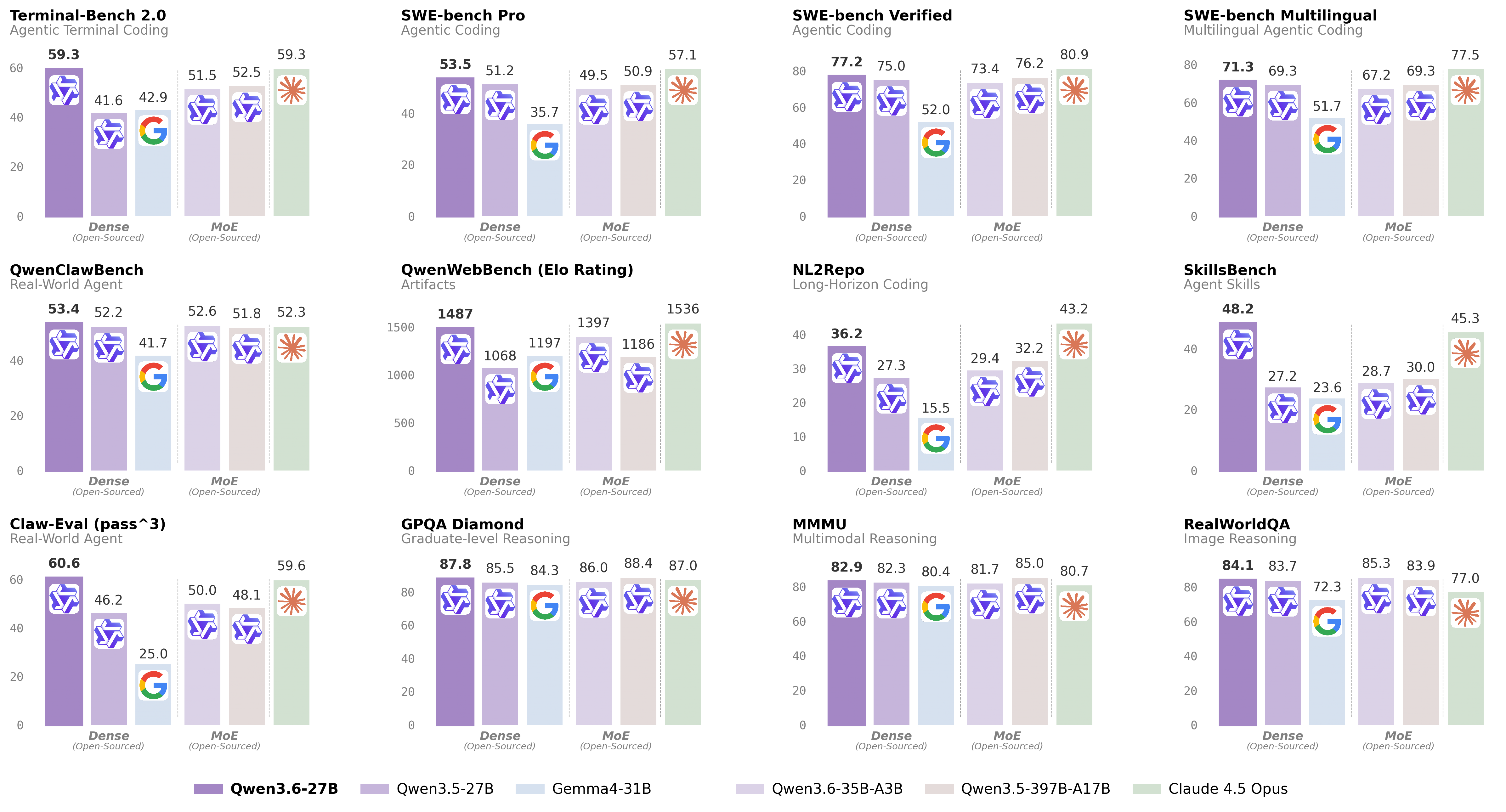
The Qwen 3.5 version (also 40B) got 181 likes+ This version uses the new Qwen 3.6 27B arch (which exceeds even Qwen's own 398B model). WARNING: This model has character and intelligence. It will take no prisoners. It will give no quarter. Uncensored, Unfiltered and boldly confident. Not even remotely "SFW", if you ask it for NSFW content. And it is wickedly smart too - exceeding the base model in 6 out of 7 benchmarks. Qwen3.6-40B-Claude-4.6-Opus-Deckard-Heretic-Uncensored-Thinking 40 billion parameters (dense, not moe) expanded from 27B Qwen 3.6, then trained on Claude 4.6 Opus High Reasoning dataset via Unsloth on local hardware... but there is much more to the story - in comes DECKARD. 96 layers, 1275 Tensors. (50% more than base model of 27B) Features variable length reasoning ; less complex = shorter, longer for more complex. Model performance has increased dramatically. And it has character too. A lot of character. No censorship, no nanny. (via Heretic) And it is very, very smart. ...

Repository: localaiLicense: apache-2.0

gemma-4-31b-it
Google Gemma 4 31B-IT is the largest dense model in the Gemma 4 family with 31B parameters. It handles text and image input, generating text output, with a 256K context window and support for 140+ languages. Provides the highest quality outputs in the Gemma 4 lineup, well-suited for complex reasoning, summarization, and image understanding tasks.

Repository: localaiLicense: apache-2.0

liquidai_lfm2-8b-a1b
LFM2 is a new generation of hybrid models developed by Liquid AI, specifically designed for edge AI and on-device deployment. It sets a new standard in terms of quality, speed, and memory efficiency. We're releasing the weights of our first MoE based on LFM2, with 8.3B total parameters and 1.5B active parameters. LFM2-8B-A1B is the best on-device MoE in terms of both quality (comparable to 3-4B dense models) and speed (faster than Qwen3-1.7B). Code and knowledge capabilities are significantly improved compared to LFM2-2.6B. Quantized variants fit comfortably on high-end phones, tablets, and laptops.

Repository: localaiLicense: lfm1.0

qwen3-30b-a3b
Qwen3 is the latest generation of large language models in Qwen series, offering a comprehensive suite of dense and mixture-of-experts (MoE) models. Built upon extensive training, Qwen3 delivers groundbreaking advancements in reasoning, instruction-following, agent capabilities, and multilingual support, with the following key features: Uniquely support of seamless switching between thinking mode (for complex logical reasoning, math, and coding) and non-thinking mode (for efficient, general-purpose dialogue) within single model, ensuring optimal performance across various scenarios. Significantly enhancement in its reasoning capabilities, surpassing previous QwQ (in thinking mode) and Qwen2.5 instruct models (in non-thinking mode) on mathematics, code generation, and commonsense logical reasoning. Superior human preference alignment, excelling in creative writing, role-playing, multi-turn dialogues, and instruction following, to deliver a more natural, engaging, and immersive conversational experience. Expertise in agent capabilities, enabling precise integration with external tools in both thinking and unthinking modes and achieving leading performance among open-source models in complex agent-based tasks. Support of 100+ languages and dialects with strong capabilities for multilingual instruction following and translation. Qwen3-30B-A3B has the following features: Type: Causal Language Models Training Stage: Pretraining & Post-training Number of Parameters: 30.5B in total and 3.3B activated Number of Paramaters (Non-Embedding): 29.9B Number of Layers: 48 Number of Attention Heads (GQA): 32 for Q and 4 for KV Number of Experts: 128 Number of Activated Experts: 8 Context Length: 32,768 natively and 131,072 tokens with YaRN. For more details, including benchmark evaluation, hardware requirements, and inference performance, please refer to our blog, GitHub, and Documentation.

Repository: localaiLicense: apache-2.0

qwen3-reranker-0.6b
The Qwen3 Embedding model series is the latest proprietary model of the Qwen family, specifically designed for text embedding and ranking tasks. Building upon the dense foundational models of the Qwen3 series, it provides a comprehensive range of text embeddings and reranking models in various sizes (0.6B, 4B, and 8B). This series inherits the exceptional multilingual capabilities, long-text understanding, and reasoning skills of its foundational model. The Qwen3 Embedding series represents significant advancements in multiple text embedding and ranking tasks, including text retrieval, code retrieval, text classification, text clustering, and bitext mining. **Exceptional Versatility**: The embedding model has achieved state-of-the-art performance across a wide range of downstream application evaluations. The 8B size embedding model ranks No.1 in the MTEB multilingual leaderboard (as of June 5, 2025, score 70.58), while the reranking model excels in various text retrieval scenarios. **Comprehensive Flexibility**: The Qwen3 Embedding series offers a full spectrum of sizes (from 0.6B to 8B) for both embedding and reranking models, catering to diverse use cases that prioritize efficiency and effectiveness. Developers can seamlessly combine these two modules. Additionally, the embedding model allows for flexible vector definitions across all dimensions, and both embedding and reranking models support user-defined instructions to enhance performance for specific tasks, languages, or scenarios. **Multilingual Capability**: The Qwen3 Embedding series offer support for over 100 languages, thanks to the multilingual capabilites of Qwen3 models. This includes various programming languages, and provides robust multilingual, cross-lingual, and code retrieval capabilities. **Qwen3-Reranker-0.6B** has the following features: - Model Type: Text Reranking - Supported Languages: 100+ Languages - Number of Paramaters: 0.6B - Context Length: 32k - Quantization: q4_K_M, q5_0, q5_K_M, q6_K, q8_0, f16

Repository: localaiLicense: apache-2.0

qwen3-32b
Qwen3 is the latest generation of large language models in Qwen series, offering a comprehensive suite of dense and mixture-of-experts (MoE) models. Built upon extensive training, Qwen3 delivers groundbreaking advancements in reasoning, instruction-following, agent capabilities, and multilingual support, with the following key features: Uniquely support of seamless switching between thinking mode (for complex logical reasoning, math, and coding) and non-thinking mode (for efficient, general-purpose dialogue) within single model, ensuring optimal performance across various scenarios. Significantly enhancement in its reasoning capabilities, surpassing previous QwQ (in thinking mode) and Qwen2.5 instruct models (in non-thinking mode) on mathematics, code generation, and commonsense logical reasoning. Superior human preference alignment, excelling in creative writing, role-playing, multi-turn dialogues, and instruction following, to deliver a more natural, engaging, and immersive conversational experience. Expertise in agent capabilities, enabling precise integration with external tools in both thinking and unthinking modes and achieving leading performance among open-source models in complex agent-based tasks. Support of 100+ languages and dialects with strong capabilities for multilingual instruction following and translation. Qwen3-32B has the following features: Type: Causal Language Models Training Stage: Pretraining & Post-training Number of Parameters: 32.8B Number of Paramaters (Non-Embedding): 31.2B Number of Layers: 64 Number of Attention Heads (GQA): 64 for Q and 8 for KV Context Length: 32,768 natively and 131,072 tokens with YaRN. For more details, including benchmark evaluation, hardware requirements, and inference performance, please refer to our blog, GitHub, and Documentation.

Repository: localaiLicense: apache-2.0
qwen3-14b
Qwen3 is the latest generation of large language models in Qwen series, offering a comprehensive suite of dense and mixture-of-experts (MoE) models. Built upon extensive training, Qwen3 delivers groundbreaking advancements in reasoning, instruction-following, agent capabilities, and multilingual support, with the following key features: Uniquely support of seamless switching between thinking mode (for complex logical reasoning, math, and coding) and non-thinking mode (for efficient, general-purpose dialogue) within single model, ensuring optimal performance across various scenarios. Significantly enhancement in its reasoning capabilities, surpassing previous QwQ (in thinking mode) and Qwen2.5 instruct models (in non-thinking mode) on mathematics, code generation, and commonsense logical reasoning. Superior human preference alignment, excelling in creative writing, role-playing, multi-turn dialogues, and instruction following, to deliver a more natural, engaging, and immersive conversational experience. Expertise in agent capabilities, enabling precise integration with external tools in both thinking and unthinking modes and achieving leading performance among open-source models in complex agent-based tasks. Support of 100+ languages and dialects with strong capabilities for multilingual instruction following and translation. Qwen3-14B has the following features: Type: Causal Language Models Training Stage: Pretraining & Post-training Number of Parameters: 14.8B Number of Paramaters (Non-Embedding): 13.2B Number of Layers: 40 Number of Attention Heads (GQA): 40 for Q and 8 for KV Context Length: 32,768 natively and 131,072 tokens with YaRN. For more details, including benchmark evaluation, hardware requirements, and inference performance, please refer to our blog, GitHub, and Documentation.

Repository: localaiLicense: apache-2.0
qwen3-8b
Qwen3 is the latest generation of large language models in Qwen series, offering a comprehensive suite of dense and mixture-of-experts (MoE) models. Built upon extensive training, Qwen3 delivers groundbreaking advancements in reasoning, instruction-following, agent capabilities, and multilingual support, with the following key features: Uniquely support of seamless switching between thinking mode (for complex logical reasoning, math, and coding) and non-thinking mode (for efficient, general-purpose dialogue) within single model, ensuring optimal performance across various scenarios. Significantly enhancement in its reasoning capabilities, surpassing previous QwQ (in thinking mode) and Qwen2.5 instruct models (in non-thinking mode) on mathematics, code generation, and commonsense logical reasoning. Superior human preference alignment, excelling in creative writing, role-playing, multi-turn dialogues, and instruction following, to deliver a more natural, engaging, and immersive conversational experience. Expertise in agent capabilities, enabling precise integration with external tools in both thinking and unthinking modes and achieving leading performance among open-source models in complex agent-based tasks. Support of 100+ languages and dialects with strong capabilities for multilingual instruction following and translation. Model Overview Qwen3-8B has the following features: Type: Causal Language Models Training Stage: Pretraining & Post-training Number of Parameters: 8.2B Number of Paramaters (Non-Embedding): 6.95B Number of Layers: 36 Number of Attention Heads (GQA): 32 for Q and 8 for KV Context Length: 32,768 natively and 131,072 tokens with YaRN.

Repository: localaiLicense: apache-2.0

qwen3-4b
Qwen3 is the latest generation of large language models in Qwen series, offering a comprehensive suite of dense and mixture-of-experts (MoE) models. Built upon extensive training, Qwen3 delivers groundbreaking advancements in reasoning, instruction-following, agent capabilities, and multilingual support, with the following key features: Uniquely support of seamless switching between thinking mode (for complex logical reasoning, math, and coding) and non-thinking mode (for efficient, general-purpose dialogue) within single model, ensuring optimal performance across various scenarios. Significantly enhancement in its reasoning capabilities, surpassing previous QwQ (in thinking mode) and Qwen2.5 instruct models (in non-thinking mode) on mathematics, code generation, and commonsense logical reasoning. Superior human preference alignment, excelling in creative writing, role-playing, multi-turn dialogues, and instruction following, to deliver a more natural, engaging, and immersive conversational experience. Expertise in agent capabilities, enabling precise integration with external tools in both thinking and unthinking modes and achieving leading performance among open-source models in complex agent-based tasks. Support of 100+ languages and dialects with strong capabilities for multilingual instruction following and translation. Qwen3-4B has the following features: Type: Causal Language Models Training Stage: Pretraining & Post-training Number of Parameters: 4.0B Number of Paramaters (Non-Embedding): 3.6B Number of Layers: 36 Number of Attention Heads (GQA): 32 for Q and 8 for KV Context Length: 32,768 natively and 131,072 tokens with YaRN.

Repository: localaiLicense: apache-2.0

qwen3-1.7b
Qwen3 is the latest generation of large language models in Qwen series, offering a comprehensive suite of dense and mixture-of-experts (MoE) models. Built upon extensive training, Qwen3 delivers groundbreaking advancements in reasoning, instruction-following, agent capabilities, and multilingual support, with the following key features: Uniquely support of seamless switching between thinking mode (for complex logical reasoning, math, and coding) and non-thinking mode (for efficient, general-purpose dialogue) within single model, ensuring optimal performance across various scenarios. Significantly enhancement in its reasoning capabilities, surpassing previous QwQ (in thinking mode) and Qwen2.5 instruct models (in non-thinking mode) on mathematics, code generation, and commonsense logical reasoning. Superior human preference alignment, excelling in creative writing, role-playing, multi-turn dialogues, and instruction following, to deliver a more natural, engaging, and immersive conversational experience. Expertise in agent capabilities, enabling precise integration with external tools in both thinking and unthinking modes and achieving leading performance among open-source models in complex agent-based tasks. Support of 100+ languages and dialects with strong capabilities for multilingual instruction following and translation. Qwen3-1.7B has the following features: Type: Causal Language Models Training Stage: Pretraining & Post-training Number of Parameters: 1.7B Number of Paramaters (Non-Embedding): 1.4B Number of Layers: 28 Number of Attention Heads (GQA): 16 for Q and 8 for KV Context Length: 32,768

Repository: localaiLicense: apache-2.0

qwen3-0.6b
Qwen3 is the latest generation of large language models in Qwen series, offering a comprehensive suite of dense and mixture-of-experts (MoE) models. Built upon extensive training, Qwen3 delivers groundbreaking advancements in reasoning, instruction-following, agent capabilities, and multilingual support, with the following key features: Uniquely support of seamless switching between thinking mode (for complex logical reasoning, math, and coding) and non-thinking mode (for efficient, general-purpose dialogue) within single model, ensuring optimal performance across various scenarios. Significantly enhancement in its reasoning capabilities, surpassing previous QwQ (in thinking mode) and Qwen2.5 instruct models (in non-thinking mode) on mathematics, code generation, and commonsense logical reasoning. Superior human preference alignment, excelling in creative writing, role-playing, multi-turn dialogues, and instruction following, to deliver a more natural, engaging, and immersive conversational experience. Expertise in agent capabilities, enabling precise integration with external tools in both thinking and unthinking modes and achieving leading performance among open-source models in complex agent-based tasks. Support of 100+ languages and dialects with strong capabilities for multilingual instruction following and translation. Qwen3-0.6B has the following features: Type: Causal Language Models Training Stage: Pretraining & Post-training Number of Parameters: 0.6B Number of Paramaters (Non-Embedding): 0.44B Number of Layers: 28 Number of Attention Heads (GQA): 16 for Q and 8 for KV Context Length: 32,768

Repository: localaiLicense: apache-2.0

qwen3-embedding-4b
The Qwen3 Embedding model series is the latest proprietary model of the Qwen family, specifically designed for text embedding and ranking tasks. Building upon the dense foundational models of the Qwen3 series, it provides a comprehensive range of text embeddings and reranking models in various sizes (0.6B, 4B, and 8B). This series inherits the exceptional multilingual capabilities, long-text understanding, and reasoning skills of its foundational model. The Qwen3 Embedding series represents significant advancements in multiple text embedding and ranking tasks, including text retrieval, code retrieval, text classification, text clustering, and bitext mining. **Exceptional Versatility**: The embedding model has achieved state-of-the-art performance across a wide range of downstream application evaluations. The 8B size embedding model ranks **No.1** in the MTEB multilingual leaderboard (as of June 5, 2025, score **70.58**), while the reranking model excels in various text retrieval scenarios. **Comprehensive Flexibility**: The Qwen3 Embedding series offers a full spectrum of sizes (from 0.6B to 8B) for both embedding and reranking models, catering to diverse use cases that prioritize efficiency and effectiveness. Developers can seamlessly combine these two modules. Additionally, the embedding model allows for flexible vector definitions across all dimensions, and both embedding and reranking models support user-defined instructions to enhance performance for specific tasks, languages, or scenarios. **Multilingual Capability**: The Qwen3 Embedding series offer support for over 100 languages, thanks to the multilingual capabilites of Qwen3 models. This includes various programming languages, and provides robust multilingual, cross-lingual, and code retrieval capabilities. **Qwen3-Embedding-4B-GGUF** has the following features: - Model Type: Text Embedding - Supported Languages: 100+ Languages - Number of Paramaters: 4B - Context Length: 32k - Embedding Dimension: Up to 2560, supports user-defined output dimensions ranging from 32 to 2560 - Quantization: q4_K_M, q5_0, q5_K_M, q6_K, q8_0, f16

Repository: localaiLicense: apache-2.0

qwen3-embedding-8b
The Qwen3 Embedding series model series is the latest proprietary model of the Qwen family, specifically designed for text embedding and ranking tasks. Building upon the dense foundational models of the Qwen3 series, it provides a comprehensive range of text embeddings and reranking models in various sizes (0.6B, 4B, and 8B). This series inherits the exceptional multilingual capabilities, long-text understanding, and reasoning skills of its foundational model. The Qwen3 Embedding series represents significant advancements in multiple text embedding and ranking tasks, including text retrieval, code retrieval, text classification, text clustering, and bitext mining. **Exceptional Versatility**: The embedding model has achieved state-of-the-art performance across a wide range of downstream application evaluations. The 8B size embedding model ranks **No.1** in the MTEB multilingual leaderboard (as of June 5, 2025, score **70.58**), while the reranking model excels in various text retrieval scenarios. **Comprehensive Flexibility**: The Qwen3 Embedding series offers a full spectrum of sizes (from 0.6B to 8B) for both embedding and reranking models, catering to diverse use cases that prioritize efficiency and effectiveness. Developers can seamlessly combine these two modules. Additionally, the embedding model allows for flexible vector definitions across all dimensions, and both embedding and reranking models support user-defined instructions to enhance performance for specific tasks, languages, or scenarios. **Multilingual Capability**: The Qwen3 Embedding series offer support for over 100 languages, thanks to the multilingual capabilites of Qwen3 models. This includes various programming languages, and provides robust multilingual, cross-lingual, and code retrieval capabilities. **Qwen3-Embedding-8B-GGUF** has the following features: - Model Type: Text Embedding - Supported Languages: 100+ Languages - Number of Paramaters: 8B - Context Length: 32k - Embedding Dimension: Up to 4096, supports user-defined output dimensions ranging from 32 to 4096 - Quantization: q4_K_M, q5_0, q5_K_M, q6_K, q8_0, f16

Repository: localaiLicense: apache-2.0

qwen3-embedding-0.6b
The Qwen3 Embedding model series is the latest proprietary model of the Qwen family, specifically designed for text embedding and ranking tasks. Building upon the dense foundational models of the Qwen3 series, it provides a comprehensive range of text embeddings and reranking models in various sizes (0.6B, 4B, and 8B). This series inherits the exceptional multilingual capabilities, long-text understanding, and reasoning skills of its foundational model. The Qwen3 Embedding series represents significant advancements in multiple text embedding and ranking tasks, including text retrieval, code retrieval, text classification, text clustering, and bitext mining. **Exceptional Versatility**: The embedding model has achieved state-of-the-art performance across a wide range of downstream application evaluations. The 8B size embedding model ranks **No.1** in the MTEB multilingual leaderboard (as of June 5, 2025, score **70.58**), while the reranking model excels in various text retrieval scenarios. **Comprehensive Flexibility**: The Qwen3 Embedding series offers a full spectrum of sizes (from 0.6B to 8B) for both embedding and reranking models, catering to diverse use cases that prioritize efficiency and effectiveness. Developers can seamlessly combine these two modules. Additionally, the embedding model allows for flexible vector definitions across all dimensions, and both embedding and reranking models support user-defined instructions to enhance performance for specific tasks, languages, or scenarios. **Multilingual Capability**: The Qwen3 Embedding series offer support for over 100 languages, thanks to the multilingual capabilites of Qwen3 models. This includes various programming languages, and provides robust multilingual, cross-lingual, and code retrieval capabilities. **Qwen3-Embedding-0.6B-GGUF** has the following features: - Model Type: Text Embedding - Supported Languages: 100+ Languages - Number of Paramaters: 0.6B - Context Length: 32k - Embedding Dimension: Up to 1024, supports user-defined output dimensions ranging from 32 to 1024 - Quantization: q8_0, f16

Repository: localaiLicense: apache-2.0

mini-hydra
A specialized reasoning-focused MoE model based on Qwen3-30B-A3Bn Mini-Hydra is a Mixture-of-Experts (MoE) language model designed for efficient reasoning and faster conclusion generation. Built upon the Qwen3-30B-A3B architecture, this model aims to bridge the performance gap between sparse MoE models and their dense counterparts while maintaining computational efficiency. The model was trained on a carefully curated combination of reasoning-focused datasets: Tesslate/Gradient-Reasoning: Advanced reasoning problems with step-by-step solutions Daemontatox/curated_thoughts_convs: Curated conversational data emphasizing thoughtful responses Daemontatox/natural_reasoning: Natural language reasoning examples and explanations Daemontatox/numina_math_cconvs: Mathematical conversation and problem-solving data

Repository: localaiLicense: apache-2.0

aquif-ai_aquif-3.5-8b-think
The aquif-3.5 series is the successor to aquif-3, featuring a simplified naming scheme, expanded Mixture of Experts (MoE) options, and across-the-board performance improvements. This release streamlines model selection while delivering enhanced capabilities across reasoning, multilingual support, and general intelligence tasks. An experimental small-scale Mixture of Experts model designed for multilingual applications with minimal computational overhead. Despite its compact active parameter count, it demonstrates competitive performance against larger dense models.

Repository: localaiLicense: apache-2.0

granite-embedding-107m-multilingual
Granite-Embedding-107M-Multilingual is a 107M parameter dense biencoder embedding model from the Granite Embeddings suite that can be used to generate high quality text embeddings. This model produces embedding vectors of size 384 and is trained using a combination of open source relevance-pair datasets with permissive, enterprise-friendly license, and IBM collected and generated datasets. This model is developed using contrastive finetuning, knowledge distillation and model merging for improved performance.

Repository: localaiLicense: apache-2.0

granite-embedding-125m-english
Granite-Embedding-125m-English is a 125M parameter dense biencoder embedding model from the Granite Embeddings suite that can be used to generate high quality text embeddings. This model produces embedding vectors of size 768. Compared to most other open-source models, this model was only trained using open-source relevance-pair datasets with permissive, enterprise-friendly license, plus IBM collected and generated datasets. While maintaining competitive scores on academic benchmarks such as BEIR, this model also performs well on many enterprise use cases. This model is developed using retrieval oriented pretraining, contrastive finetuning and knowledge distillation.

Repository: localaiLicense: apache-2.0

sparse-llama-3.1-8b-2of4
This is the 2:4 sparse version of Llama-3.1-8B. On the OpenLLM benchmark (version 1), it achieves an average score of 62.16, compared to 63.19 for the dense model—demonstrating a 98.37% accuracy recovery. On the Mosaic Eval Gauntlet benchmark (version v0.3), it achieves an average score of 53.85, versus 55.34 for the dense model—representing a 97.3% accuracy recovery.

Repository: localaiLicense: llama3.1

mistral-small-24b-instruct-2501
Mistral Small 3 ( 2501 ) sets a new benchmark in the "small" Large Language Models category below 70B, boasting 24B parameters and achieving state-of-the-art capabilities comparable to larger models! This model is an instruction-fine-tuned version of the base model: Mistral-Small-24B-Base-2501. Mistral Small can be deployed locally and is exceptionally "knowledge-dense", fitting in a single RTX 4090 or a 32GB RAM MacBook once quantized.

Repository: localaiLicense: apache-2.0

mistralai_mistral-small-3.1-24b-instruct-2503
Building upon Mistral Small 3 (2501), Mistral Small 3.1 (2503) adds state-of-the-art vision understanding and enhances long context capabilities up to 128k tokens without compromising text performance. With 24 billion parameters, this model achieves top-tier capabilities in both text and vision tasks. This model is an instruction-finetuned version of: Mistral-Small-3.1-24B-Base-2503. Mistral Small 3.1 can be deployed locally and is exceptionally "knowledge-dense," fitting within a single RTX 4090 or a 32GB RAM MacBook once quantized.

Repository: localaiLicense: apache-2.0

Page 1