Filter by type:
Filter by tags:
gemma-4-26b-a4b-it-qat
Hugging Face |
GitHub |
Launch Blog |
Documentation
License: Apache 2.0 | Authors: Google DeepMind
> [!Note]
> This model card is for the new versions of the Gemma 4 family optimized with Quantization-Aware Training (QAT), which allows preserving similar quality to bfloat16 while dramatically reducing the memory requirements to load the model.
> Four versions of the QAT checkpoints are available:
> * **Unquantized QAT checkpoints** (Q4_0): Half-precision weights extracted from the QAT pipeline, ideal for custom downstream compilation and research. Available for Gemma 4 E2B, E4B, 12B, 26B A4B, and 31B, and their drafter models.
> * **GGUF** (Q4_0): Ready-to-deploy formats for broad ecosystem compatibility. Available for Gemma 4 E2B, E4B, 12B, 26B A4B, and 31B.
> * **Mobile-optimized** (wNa8o8): A custom schema engineered explicitly for mobile hardware efficiency. It features targeted 2-bit decoding layers, optimized KV caches, and static activations to maximize VRAM savings. Available for Gemma 4 E2B and E4B.
> * **Compressed Tensors** (w4a16): QAT checkpoints serialized in the compressed-tensors format for native, optimized inference with vLLM. Available for Gemma 4 E2B, E4B, 12B
...
Repository: localaiLicense: apache-2.0
gemma-4-12b-it-qat-q4_0
Hugging Face |
GitHub |
Launch Blog |
Documentation
License: Apache 2.0 | Authors: Google DeepMind
> [!Note]
> This model card is for the new versions of the Gemma 4 family optimized with Quantization-Aware Training (QAT), which allows preserving similar quality to bfloat16 while dramatically reducing the memory requirements to load the model.
> Four versions of the QAT checkpoints are available:
> * **Unquantized QAT checkpoints** (Q4_0): Half-precision weights extracted from the QAT pipeline, ideal for custom downstream compilation and research. Available for Gemma 4 E2B, E4B, 12B, 26B A4B, and 31B, and their drafter models.
> * **GGUF** (Q4_0): Ready-to-deploy formats for broad ecosystem compatibility. Available for Gemma 4 E2B, E4B, 12B, 26B A4B, and 31B.
> * **Mobile-optimized** (wNa8o8): A custom schema engineered explicitly for mobile hardware efficiency. It features targeted 2-bit decoding layers, optimized KV caches, and static activations to maximize VRAM savings. Available for Gemma 4 E2B and E4B.
> * **Compressed Tensors** (w4a16): QAT checkpoints serialized in the compressed-tensors format for native, optimized inference with vLLM. Available for Gemma 4 E2B, E4B, 12B
...
Repository: localaiLicense: apache-2.0
gemma-4-e2b-it-qat-q4_0
Gemma 4 E2B is a multimodal (text + image) instruction-tuned model from Google DeepMind, optimized with Quantization-Aware Training (QAT) to preserve bfloat16-level quality at a fraction of the memory. E2B is a MatFormer "effective 2B" elastic variant: it carries a larger backbone but runs at an effective 2B-parameter footprint, making it well suited to lightweight and on-device deployments. This is the official Google Q4_0 GGUF, shipped with its multimodal projector.
License: Apache 2.0 | Authors: Google DeepMind
Repository: localaiLicense: apache-2.0
gemma-4-e4b-it-qat-q4_0
Gemma 4 E4B is a multimodal (text + image) instruction-tuned model from Google DeepMind, optimized with Quantization-Aware Training (QAT) to preserve bfloat16-level quality at a fraction of the memory. E4B is a MatFormer "effective 4B" elastic variant, balancing quality and footprint for on-device and edge deployments. This is the official Google Q4_0 GGUF, shipped with its multimodal projector.
License: Apache 2.0 | Authors: Google DeepMind
Repository: localaiLicense: apache-2.0
gemma-4-26b-a4b-it-qat-q4_0
Gemma 4 26B-A4B is a multimodal (text + image) instruction-tuned Mixture-of-Experts model from Google DeepMind, optimized with Quantization-Aware Training (QAT) to preserve bfloat16-level quality at a fraction of the memory. With 26B total parameters and ~4B active per token, it delivers large-model quality at a much lower inference cost. This is the official Google Q4_0 GGUF, shipped with its multimodal projector.
License: Apache 2.0 | Authors: Google DeepMind
Repository: localaiLicense: apache-2.0
gemma-4-31b-it-qat-q4_0
Gemma 4 31B is the largest dense multimodal (text + image) instruction-tuned model in the Gemma 4 family from Google DeepMind, optimized with Quantization-Aware Training (QAT) to preserve bfloat16-level quality while dramatically reducing the memory required to load the model. This is the official Google Q4_0 GGUF, shipped with its multimodal projector.
License: Apache 2.0 | Authors: Google DeepMind
Repository: localaiLicense: apache-2.0
gemma-4-e2b-it-qat-mtp
Gemma 4 E2B IT QAT (Google DeepMind) paired with its Multi-Token Prediction (MTP) drafter head for speculative decoding on the llama.cpp backend. The Q4_K_XL target carries the full multimodal (text + image) model; the small `mtp-gemma-4-E2B-it` head predicts several tokens ahead which the target verifies in parallel, accelerating generation with no change to output quality. E2B is a MatFormer "effective 2B" elastic variant, well suited to lightweight and on-device deployments.
The drafter is not a standalone chat model: it only runs paired with the target, which is why both are bundled here. It uses the upstream `gemma4-assistant` architecture registered by llama.cpp PR #23398, so it loads on stock llama.cpp without any patch.
License: Apache 2.0 | Authors: Google DeepMind (target/drafter checkpoints), Unsloth (GGUF conversion)
Repository: localaiLicense: apache-2.0
gemma-4-e4b-it-qat-mtp
Gemma 4 E4B IT QAT (Google DeepMind) paired with its Multi-Token Prediction (MTP) drafter head for speculative decoding on the llama.cpp backend. The Q4_K_XL target carries the full multimodal (text + image) model; the small `mtp-gemma-4-E4B-it` head predicts several tokens ahead which the target verifies in parallel, accelerating generation with no change to output quality. E4B is a MatFormer "effective 4B" elastic variant, balancing quality and footprint for on-device and edge deployments.
The drafter is not a standalone chat model: it only runs paired with the target, which is why both are bundled here. It uses the upstream `gemma4-assistant` architecture registered by llama.cpp PR #23398, so it loads on stock llama.cpp without any patch.
License: Apache 2.0 | Authors: Google DeepMind (target/drafter checkpoints), Unsloth (GGUF conversion)
Repository: localaiLicense: apache-2.0
gemma-4-12b-it-qat-mtp
Gemma 4 12B IT QAT (Google DeepMind) paired with its Multi-Token Prediction (MTP) drafter head for speculative decoding on the llama.cpp backend. The Q4_K_XL target carries the full multimodal (text + image) model; the small `mtp-gemma-4-12B-it` head predicts several tokens ahead which the target verifies in parallel, accelerating generation with no change to output quality. As a dense model, Gemma 4 12B is among the sizes that benefit most from MTP, with the llama.cpp PR reporting well over 1.4x decode speedup.
The drafter is not a standalone chat model: it only runs paired with the target, which is why both are bundled here. It uses the upstream `gemma4-assistant` architecture registered by llama.cpp PR #23398, so it loads on stock llama.cpp without any patch.
License: Apache 2.0 | Authors: Google DeepMind (target/drafter checkpoints), Unsloth (GGUF conversion)
Repository: localaiLicense: apache-2.0
gemma-4-31b-it-qat-mtp
Gemma 4 31B IT QAT (Google DeepMind), the largest dense model in the family, paired with its Multi-Token Prediction (MTP) drafter head for speculative decoding on the llama.cpp backend. The Q4_K_XL target carries the full multimodal (text + image) model; the small `mtp-gemma-4-31B-it` head predicts several tokens ahead which the target verifies in parallel, accelerating generation with no change to output quality. Dense models like 31B are the sizes that benefit most from MTP.
The drafter is not a standalone chat model: it only runs paired with the target, which is why both are bundled here. It uses the upstream `gemma4-assistant` architecture registered by llama.cpp PR #23398, so it loads on stock llama.cpp without any patch.
License: Apache 2.0 | Authors: Google DeepMind (target/drafter checkpoints), Unsloth (GGUF conversion)
Repository: localaiLicense: apache-2.0
openbuddy_openbuddy-r1-0528-distill-qwen3-32b-preview0-qat
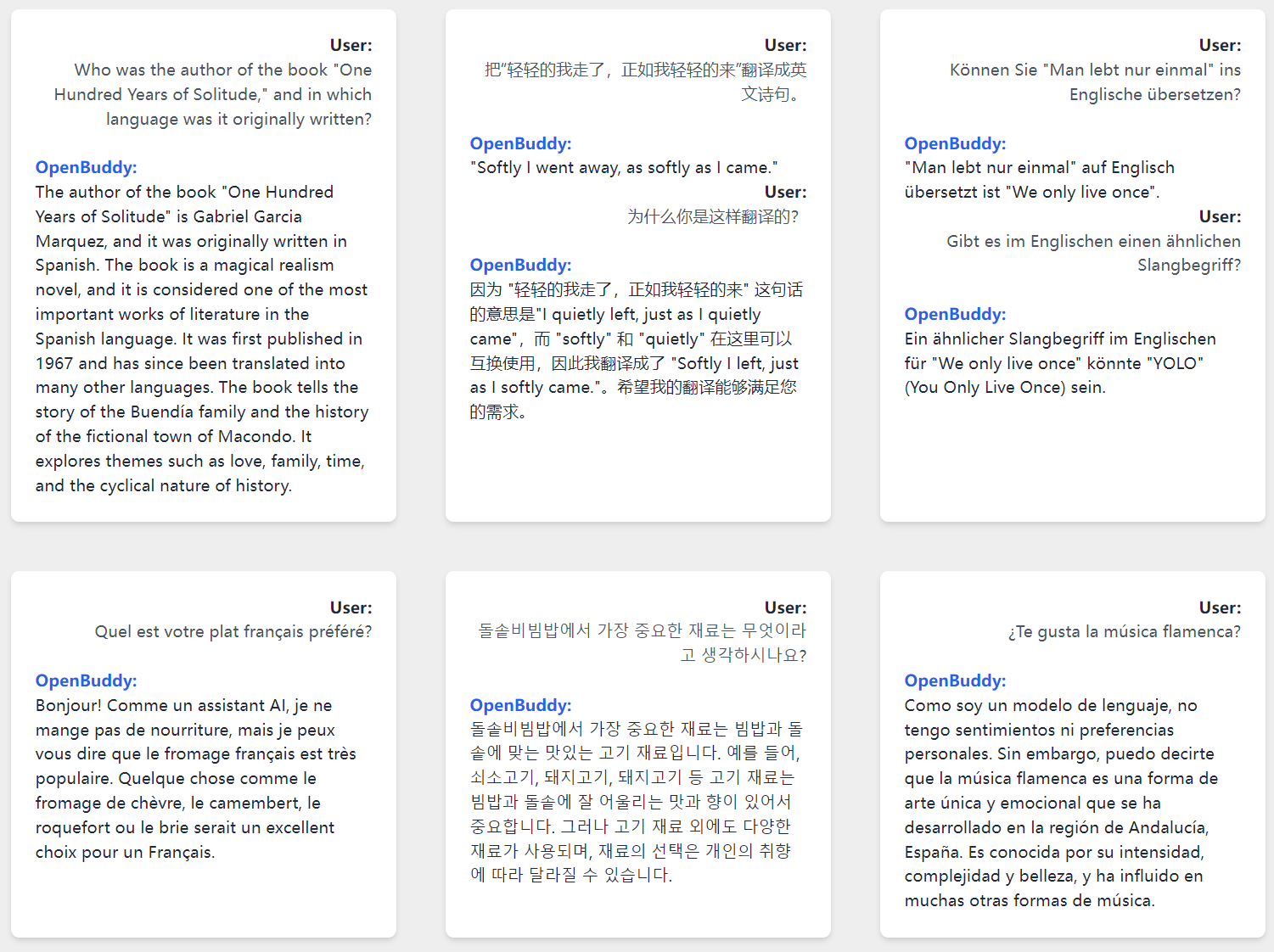
OpenBuddy distillation of Qwen3-32B from DeepSeek-R1, featuring 40K context window and multilingual support (zh, en, fr, de, ja, ko, it, fi). GGUF quantized version optimized for local inference with llama.cpp.
Repository: localaiLicense: apache-2.0

gemma-3-12b-it-qat
This model corresponds to the 12B instruction-tuned version of the Gemma 3 model in GGUF format using Quantization Aware Training (QAT). The GGUF corresponds to Q4_0 quantization.
Thanks to QAT, the model is able to preserve similar quality as bfloat16 while significantly reducing the memory requirements to load the model.
You can find the half-precision version here.
Repository: localaiLicense: gemma
gemma-3-4b-it-qat
This model corresponds to the 4B instruction-tuned version of the Gemma 3 model in GGUF format using Quantization Aware Training (QAT). The GGUF corresponds to Q4_0 quantization.
Thanks to QAT, the model is able to preserve similar quality as bfloat16 while significantly reducing the memory requirements to load the model.
You can find the half-precision version here.
Repository: localaiLicense: gemma
gemma-3-27b-it-qat
This model corresponds to the 27B instruction-tuned version of the Gemma 3 model in GGUF format using Quantization Aware Training (QAT). The GGUF corresponds to Q4_0 quantization.
Thanks to QAT, the model is able to preserve similar quality as bfloat16 while significantly reducing the memory requirements to load the model.
You can find the half-precision version here.
Repository: localaiLicense: gemma
google-gemma-3-27b-it-qat-q4_0-small
This is a requantized version of https://huggingface.co/google/gemma-3-27b-it-qat-q4_0-gguf. The official QAT weights released by google use fp16 (instead of Q6_K) for the embeddings table, which makes this model take a significant extra amount of memory (and storage) compared to what Q4_0 quants are supposed to take. Requantizing with llama.cpp achieves a very similar result. Note that this model ends up smaller than the Q4_0 from Bartowski. This is because llama.cpp sets some tensors to Q4_1 when quantizing models to Q4_0 with imatrix, but this is a static quant. The perplexity score for this one is even lower with this model compared to the original model by Google, but the results are within margin of error, so it's probably just luck. I also fixed the control token metadata, which was slightly degrading the performance of the model in instruct mode.
Repository: localaiLicense: gemma

gemma-3-12b-fornaxv.2-qat-cot
This model is an experiment to try to produce a strong smaller thinking model capable of fitting in an 8GiB consumer graphics card with generalizeable reasoning capabilities. Most other open source thinking models, especially on the smaller side, fail to generalize their reasoning to tasks other than coding or math due to an overly large focus on GRPO zero for CoT which is only applicable for coding and math.
Instead of using GRPO, this model aims to SFT a wide variety of high quality, diverse reasoning traces from Deepseek R1 onto Gemma 3 to force the model to learn to effectively generalize its reasoning capabilites to a large number of tasks as an extension of the LiMO paper's approach to Math/Coding CoT. A subset of V3 O3/24 non-thinking data was also included for improved creativity and to allow the model to retain it's non-thinking capabilites.
Training off the QAT checkpoint allows for this model to be used without a drop in quality at Q4_0, requiring only ~6GiB of memory.
Thinking Mode
Similar to the Qwen 3 model line, Gemma Fornax can be used with or without thinking mode enabled.
To enable thinking place /think in the system prompt and prefill \n for thinking mode.
To disable thinking put /no_think in the system prompt.
Repository: localaiLicense: gemma
gemma-3-270m-it-qat
Gemma is a family of lightweight, state-of-the-art open models from Google, built from the same research and technology used to create the Gemini models. Gemma 3 models are multimodal, handling text and image input and generating text output, with open weights for both pre-trained variants and instruction-tuned variants. Gemma 3 has a large, 128K context window, multilingual support in over 140 languages, and is available in more sizes than previous versions. Gemma 3 models are well-suited for a variety of text generation and image understanding tasks, including question answering, summarization, and reasoning. Their relatively small size makes it possible to deploy them in environments with limited resources such as laptops, desktops or your own cloud infrastructure, democratizing access to state of the art AI models and helping foster innovation for everyone.
This model is a QAT (Quantization Aware Training) version of the Gemma 3 270M model. It is quantized to 4-bit precision, which means that it uses 4-bit floating point numbers to represent the weights and activations of the model. This reduces the memory footprint of the model and makes it faster to run on GPUs.
Repository: localaiLicense: gemma