Model Gallery

42 models from 1 repositories

Filter by type:

Filter by tags:

qwen3.6-40b-claude-4.6-opus-deckard-heretic-uncensored-thinking-neo-code-di-imatrix-max
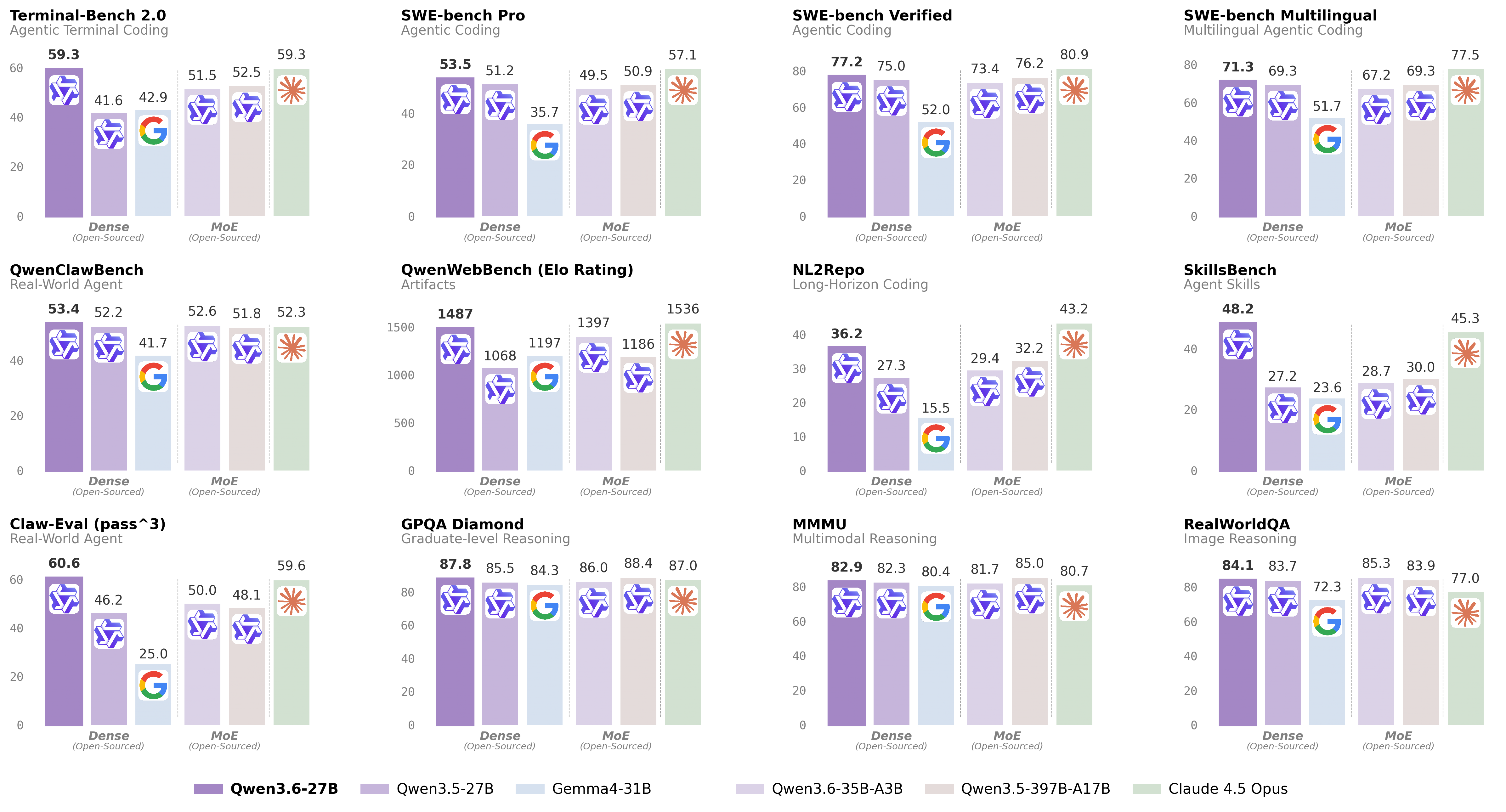
The Qwen 3.5 version (also 40B) got 181 likes+ This version uses the new Qwen 3.6 27B arch (which exceeds even Qwen's own 398B model). WARNING: This model has character and intelligence. It will take no prisoners. It will give no quarter. Uncensored, Unfiltered and boldly confident. Not even remotely "SFW", if you ask it for NSFW content. And it is wickedly smart too - exceeding the base model in 6 out of 7 benchmarks. Qwen3.6-40B-Claude-4.6-Opus-Deckard-Heretic-Uncensored-Thinking 40 billion parameters (dense, not moe) expanded from 27B Qwen 3.6, then trained on Claude 4.6 Opus High Reasoning dataset via Unsloth on local hardware... but there is much more to the story - in comes DECKARD. 96 layers, 1275 Tensors. (50% more than base model of 27B) Features variable length reasoning ; less complex = shorter, longer for more complex. Model performance has increased dramatically. And it has character too. A lot of character. No censorship, no nanny. (via Heretic) And it is very, very smart. ...

Repository: localaiLicense: apache-2.0

qwen3.6-27b-heretic-uncensored-finetune-neo-code-di-imatrix-max
Qwen3.6-27B-Heretic2-Uncensored-Finetune-Thinking Yes... fully uncensored AND fine tuned lightly. Freedom and brainpower. Trained on different Heretic base, with different KLD/Refusals. Model fine tune was used to finalize and "firm up" Heretic / uncensored changes. The goal here was light, minor fixes rather than full / heavy fine tune. That being said, the tuning still raised critical metrics. This is Version 2, using "trohrbaugh" Heretic, which has a lower refusal rate, and tuning bumped up the metrics a bit more too. This has also positively impacted "NEO-Coder Di-Matrix" (dual imatrix) GGUF quants as well (vs heretic/non heretic too). https://huggingface.co/DavidAU/Qwen3.6-27B-Heretic-Uncensored-FINETUNE-NEO-CODE-Di-IMatrix-MAX-GGUF ``` IN HOUSE BENCHMARKS [by Nightmedia]: arc-c arc/e boolq hswag obkqa piqa wino Qwen3.6-27B-Heretic2-Uncensored-Finetune-Thinking mxfp8 0.673,0.846,0.905... [instruct mode] Qwen3.6-27B-Heretic-Uncensored-Finetune-Thinking mxfp8 0.669,0.835,0.906,... [instruct mode] BASE UNTUNED MODEL: Qwen3.6-27B HERETIC (by llmfan46) [instruct mode] mxfp8 0.644,0.788,0.902,... ...

Repository: localaiLicense: apache-2.0
kimi-k2.6
🤗  huggingchat  |  📰  Tech Blog ## 1. Model Introduction Kimi K2.6 is an open-source, native multimodal agentic model that advances practical capabilities in long-horizon coding, coding-driven design, proactive autonomous execution, and swarm-based task orchestration. ### Key Features - **Long-Horizon Coding**: K2.6 achieves significant improvements on complex, end-to-end coding tasks, generalizing robustly across programming languages (Rust, Go, Python) and domains spanning front-end, DevOps, and performance optimization. - **Coding-Driven Design**: K2.6 is capable of transforming simple prompts and visual inputs into production-ready interfaces and lightweight full-stack workflows, generating structured layouts, interactive elements, and rich animations with deliberate aesthetic precision. - **Elevated Agent Swarm**: Scaling horizontally to 300 sub-agents executing 4,000 coordinated steps, K2.6 can dynamically decompose tasks into parallel, domain-specialized subtasks, delivering end-to-end outputs from documents to websites to spreadsheets in a single autonomous run. - **Proactive & Open Orchestration**: For autonomous tasks, K2.6 demonstra ...

Repository: localaiLicense: modified-mit

qwopus-glm-18b-merged
# 🪐 Qwen3.5-9B-GLM5.1-Distill-v1 ## 📌 Model Overview **Model Name:** `Jackrong/Qwen3.5-9B-GLM5.1-Distill-v1` **Base Model:** Qwen3.5-9B **Training Type:** Supervised Fine-Tuning (SFT, Distillation) **Parameter Scale:** 9B **Training Framework:** Unsloth This model is a distilled variant of **Qwen3.5-9B**, trained on high-quality reasoning data derived from **GLM-5.1**. The primary goals are to: - Improve **structured reasoning ability** - Enhance **instruction-following consistency** - Activate **latent knowledge via better reasoning structure** ## 📊 Training Data ### Main Dataset - `Jackrong/GLM-5.1-Reasoning-1M-Cleaned` - Cleaned from the original `Kassadin88/GLM-5.1-1000000x` dataset. - Generated from a **GLM-5.1 teacher model** - Approximately **700x** the scale of `Qwen3.5-reasoning-700x` - Training used a **filtered subset**, not the full source dataset. ### Auxiliary Dataset - `Jackrong/Qwen3.5-reasoning-700x` ...

Repository: localaiLicense: apache-2.0

qwen3.5-9b-glm5.1-distill-v1
# 🪐 Qwen3.5-9B-GLM5.1-Distill-v1 ## 📌 Model Overview **Model Name:** `Jackrong/Qwen3.5-9B-GLM5.1-Distill-v1` **Base Model:** Qwen3.5-9B **Training Type:** Supervised Fine-Tuning (SFT, Distillation) **Parameter Scale:** 9B **Training Framework:** Unsloth This model is a distilled variant of **Qwen3.5-9B**, trained on high-quality reasoning data derived from **GLM-5.1**. The primary goals are to: - Improve **structured reasoning ability** - Enhance **instruction-following consistency** - Activate **latent knowledge via better reasoning structure** ## 📊 Training Data ### Main Dataset - `Jackrong/GLM-5.1-Reasoning-1M-Cleaned` - Cleaned from the original `Kassadin88/GLM-5.1-1000000x` dataset. - Generated from a **GLM-5.1 teacher model** - Approximately **700x** the scale of `Qwen3.5-reasoning-700x` - Training used a **filtered subset**, not the full source dataset. ### Auxiliary Dataset - `Jackrong/Qwen3.5-reasoning-700x` ...

Repository: localaiLicense: apache-2.0
qwopus-glm-18b-merged
# 🪐 Qwen3.5-9B-GLM5.1-Distill-v1 ## 📌 Model Overview **Model Name:** `Jackrong/Qwen3.5-9B-GLM5.1-Distill-v1` **Base Model:** Qwen3.5-9B **Training Type:** Supervised Fine-Tuning (SFT, Distillation) **Parameter Scale:** 9B **Training Framework:** Unsloth This model is a distilled variant of **Qwen3.5-9B**, trained on high-quality reasoning data derived from **GLM-5.1**. The primary goals are to: - Improve **structured reasoning ability** - Enhance **instruction-following consistency** - Activate **latent knowledge via better reasoning structure** ## 📊 Training Data ### Main Dataset - `Jackrong/GLM-5.1-Reasoning-1M-Cleaned` - Cleaned from the original `Kassadin88/GLM-5.1-1000000x` dataset. - Generated from a **GLM-5.1 teacher model** - Approximately **700x** the scale of `Qwen3.5-reasoning-700x` - Training used a **filtered subset**, not the full source dataset. ### Auxiliary Dataset - `Jackrong/Qwen3.5-reasoning-700x` ...

Repository: localaiLicense: apache-2.0

rwkv7-g1c-13.3b
The model is **RWKV7 g1c 13B**, a large language model optimized for efficiency. It is quantized using **Bartowski's calibrationv5 for imatrix** to reduce memory usage while maintaining performance. The base model is **BlinkDL/rwkv7-g1**, and this version is tailored for text-generation tasks. It balances accuracy and efficiency, making it suitable for deployment in various applications.

Repository: localaiLicense: apache-2.0

tildeopen-30b-instruct-lv-i1
The **TildeOpen-30B-Instruct-LV-i1-GGUF** is a quantized version of the base model **pazars/TildeOpen-30B-Instruct-LV**, optimized for deployment. It is an instruct-based language model trained on diverse datasets, supporting multiple languages (en, de, fr, pl, ru, it, pt, cs, nl, es, fi, tr, hu, bg, uk, bs, hr, da, et, lt, ro, sk, sl, sv, no, lv, sr, sq, mk, is, mt, ga). Licensed under CC-BY-4.0, it uses the Transformers library and is designed for efficient inference. The quantized version (with imatrix format) is tailored for deployment on devices with limited resources, while the base model remains the original, high-quality version.

Repository: localaiLicense: cc-by-4.0

allenai_olmo-3.1-32b-think
The **Olmo-3.1-32B-Think** model is a large language model (LLM) optimized for efficient inference using quantized versions. It is a quantized version of the original **allenai/Olmo-3.1-32B-Think** model, developed by **bartowski** using the **imatrix** quantization method. ### Key Features: - **Base Model**: `allenai/Olmo-3.1-32B-Think` (unquantized version). - **Quantized Versions**: Available in multiple formats (e.g., `Q6_K_L`, `Q4_1`, `bf16`) with varying precision (e.g., Q8_0, Q6_K_L, Q5_K_M). These are derived from the original model using the **imatrix calibration dataset**. - **Performance**: Optimized for low-memory usage and efficient inference on GPUs/CPUs. Recommended quantization types include `Q6_K_L` (near-perfect quality) or `Q4_K_M` (default, balanced performance). - **Downloads**: Available via Hugging Face CLI. Split into multiple files if needed for large models. - **License**: Apache-2.0. ### Recommended Quantization: - Use `Q6_K_L` for highest quality (near-perfect performance). - Use `Q4_K_M` for balanced performance and size. - Avoid lower-quality options (e.g., `Q3_K_S`) unless specific hardware constraints apply. This model is ideal for deploying on GPUs/CPUs with limited memory, leveraging efficient quantization for practical use cases.

Repository: localaiLicense: apache-2.0

openai_gpt-oss-20b-neo
These are NEO Imatrix GGUFs, NEO dataset by DavidAU. NEO dataset improves overall performance, and is for all use cases. Example output below (creative), using settings below. Model also passed "hard" coding test too (6 experts); no issues (IQ4_NL). (Forcing the model to create code with no dependencies and limits of coding short cuts, with multiple loops, and in real time with no blocking in a language that does not support it normally.) Due to quanting issues with this model (which result in oddball quant sizes / mixtures), only TESTED quants will be uploaded (at the moment).

Repository: localaiLicense: apache-2.0

openai-gpt-oss-20b-abliterated-uncensored-neo-imatrix
These are NEO Imatrix GGUFs, NEO dataset by DavidAU. NEO dataset improves overall performance, and is for all use cases. This model uses Huihui-gpt-oss-20b-BF16-abliterated as a base which DE-CENSORS the model and removes refusals. Example output below (creative; IQ4_NL), using settings below. This model can be a little rough around the edges (due to abliteration) ; make sure you see the settings below for best operation. It can also be creative, off the shelf crazy and rational too. Enjoy!

Repository: localaiLicense: apache-2.0

ds-r1-qwen3-8b-arliai-rpr-v4-small-iq-imatrix
The best RP/creative model series from ArliAI yet again. This time made based on DS-R1-0528-Qwen3-8B-Fast for a smaller memory footprint. Reduced repetitions and impersonation To add to the creativity and out of the box thinking of RpR v3, a more advanced filtering method was used in order to remove examples where the LLM repeated similar phrases or talked for the user. Any repetition or impersonation cases that happens will be due to how the base QwQ model was trained, and not because of the RpR dataset. Increased training sequence length The training sequence length was increased to 16K in order to help awareness and memory even on longer chats.

Repository: localaiLicense: apache-2.0

google-gemma-3-27b-it-qat-q4_0-small
This is a requantized version of https://huggingface.co/google/gemma-3-27b-it-qat-q4_0-gguf. The official QAT weights released by google use fp16 (instead of Q6_K) for the embeddings table, which makes this model take a significant extra amount of memory (and storage) compared to what Q4_0 quants are supposed to take. Requantizing with llama.cpp achieves a very similar result. Note that this model ends up smaller than the Q4_0 from Bartowski. This is because llama.cpp sets some tensors to Q4_1 when quantizing models to Q4_0 with imatrix, but this is a static quant. The perplexity score for this one is even lower with this model compared to the original model by Google, but the results are within margin of error, so it's probably just luck. I also fixed the control token metadata, which was slightly degrading the performance of the model in instruct mode.

Repository: localaiLicense: gemma

gemma-3-4b-it-max-horror-uncensored-dbl-x-imatrix
Google's newest Gemma-3 model that has been uncensored by David_AU (maintains instruction following / model performance and adds 4 layers to the model) and re-enforced with a system prompt (optional) - see below. The "Horror Imatrix" was built using Grand Horror 16B (at my repo). This adds a "tint" of horror to the model. 5 examples provided (NSFW / F-Bombs galore) below with prompts at IQ4XS (56 t/s on mid level card). Context: 128k. "MAXED" This means the embed and output tensor are set at "BF16" (full precision) for all quants. This enhances quality, depth and general performance at the cost of a slightly larger quant. "HORROR IMATRIX" A strong, in house built, imatrix dataset built by David_AU which results in better overall function, instruction following, output quality and stronger connections to ideas, concepts and the world in general. This combines with "MAXing" the quant to improve preformance.

Repository: localaiLicense: apache-2.0

suayptalha_maestro-10b
Maestro-10B is a 10 billion parameter model fine-tuned from Virtuoso-Lite, a next-generation language model developed by arcee-ai. Virtuoso-Lite itself is based on the Llama-3 architecture, distilled from Deepseek-v3 using approximately 1.1 billion tokens/logits. This distillation process allows Virtuoso-Lite to achieve robust performance with a smaller parameter count, excelling in reasoning, code generation, and mathematical problem-solving. Maestro-10B inherits these strengths from its base model, Virtuoso-Lite, and further enhances them through fine-tuning on the OpenOrca dataset. This combination of a distilled base model and targeted fine-tuning makes Maestro-10B a powerful and efficient language model.

Repository: localaiLicense: falcon-llm-license

dolphin3.0-llama3.2-1b
Dolphin 3.0 is the next generation of the Dolphin series of instruct-tuned models. Designed to be the ultimate general purpose local model, enabling coding, math, agentic, function calling, and general use cases. Dolphin aims to be a general purpose model, similar to the models behind ChatGPT, Claude, Gemini. But these models present problems for businesses seeking to include AI in their products. They maintain control of the system prompt, deprecating and changing things as they wish, often causing software to break. They maintain control of the model versions, sometimes changing things silently, or deprecating older models that your business relies on. They maintain control of the alignment, and in particular the alignment is one-size-fits all, not tailored to the application. They can see all your queries and they can potentially use that data in ways you wouldn't want. Dolphin, in contrast, is steerable and gives control to the system owner. You set the system prompt. You decide the alignment. You have control of your data. Dolphin does not impose its ethics or guidelines on you. You are the one who decides the guidelines. Dolphin belongs to YOU, it is your tool, an extension of your will. Just as you are personally responsible for what you do with a knife, gun, fire, car, or the internet, you are the creator and originator of any content you generate with Dolphin.

Repository: localaiLicense: llama3.2

dolphin3.0-llama3.2-3b
Dolphin 3.0 is the next generation of the Dolphin series of instruct-tuned models. Designed to be the ultimate general purpose local model, enabling coding, math, agentic, function calling, and general use cases. Dolphin aims to be a general purpose model, similar to the models behind ChatGPT, Claude, Gemini. But these models present problems for businesses seeking to include AI in their products. They maintain control of the system prompt, deprecating and changing things as they wish, often causing software to break. They maintain control of the model versions, sometimes changing things silently, or deprecating older models that your business relies on. They maintain control of the alignment, and in particular the alignment is one-size-fits all, not tailored to the application. They can see all your queries and they can potentially use that data in ways you wouldn't want. Dolphin, in contrast, is steerable and gives control to the system owner. You set the system prompt. You decide the alignment. You have control of your data. Dolphin does not impose its ethics or guidelines on you. You are the one who decides the guidelines. Dolphin belongs to YOU, it is your tool, an extension of your will. Just as you are personally responsible for what you do with a knife, gun, fire, car, or the internet, you are the creator and originator of any content you generate with Dolphin.

Repository: localaiLicense: llama3.2

meta-llama-3.1-8b-claude-imat
Meta-Llama-3.1-8B-Claude-iMat-GGUF: Quantized from Meta-Llama-3.1-8B-Claude fp16. Weighted quantizations were creating using fp16 GGUF and groups_merged.txt in 88 chunks and n_ctx=512. Static fp16 will also be included in repo. For a brief rundown of iMatrix quant performance, please see this PR. All quants are verified working prior to uploading to repo for your safety and convenience.

Repository: localaiLicense: llama3.1

llama-3.1-70b-japanese-instruct-2407
The Llama-3.1-70B-Japanese-Instruct-2407-gguf model is a Japanese language model that uses the Instruct prompt tuning method. It is based on the LLaMa-3.1-70B model and has been fine-tuned on the imatrix dataset for Japanese. The model is trained to generate informative and coherent responses to given instructions or prompts. It is available in the gguf format and can be used for a variety of tasks such as question answering, text generation, and more.

Repository: localaiLicense: llama3.1

llama-3.1-storm-8b-q4_k_m
We present the Llama-3.1-Storm-8B model that outperforms Meta AI's Llama-3.1-8B-Instruct and Hermes-3-Llama-3.1-8B models significantly across diverse benchmarks as shown in the performance comparison plot in the next section. Our approach consists of three key steps: - Self-Curation: We applied two self-curation methods to select approximately 1 million high-quality examples from a pool of about 3 million open-source examples. Our curation criteria focused on educational value and difficulty level, using the same SLM for annotation instead of larger models (e.g. 70B, 405B). - Targeted fine-tuning: We performed Spectrum-based targeted fine-tuning over the Llama-3.1-8B-Instruct model. The Spectrum method accelerates training by selectively targeting layer modules based on their signal-to-noise ratio (SNR), and freezing the remaining modules. In our work, 50% of layers are frozen. - Model Merging: We merged our fine-tuned model with the Llama-Spark model using SLERP method. The merging method produces a blended model with characteristics smoothly interpolated from both parent models, ensuring the resultant model captures the essence of both its parents. Llama-3.1-Storm-8B improves Llama-3.1-8B-Instruct across 10 diverse benchmarks. These benchmarks cover areas such as instruction-following, knowledge-driven QA, reasoning, truthful answer generation, and function calling.

Repository: localaiLicense: llama3.1

llama-3.1-swallow-70b-v0.1-i1
Llama 3.1 Swallow is a series of large language models (8B, 70B) that were built by continual pre-training on the Meta Llama 3.1 models. Llama 3.1 Swallow enhanced the Japanese language capabilities of the original Llama 3.1 while retaining the English language capabilities. We use approximately 200 billion tokens that were sampled from a large Japanese web corpus (Swallow Corpus Version 2), Japanese and English Wikipedia articles, and mathematical and coding contents, etc (see the Training Datasets section) for continual pre-training. The instruction-tuned models (Instruct) were built by supervised fine-tuning (SFT) on the synthetic data specially built for Japanese. See the Swallow Model Index section to find other model variants.

Repository: localaiLicense: llama3.1

Page 1